


Without Juniors, Where Will the Next Seniors Come From?
I spent nearly 12 years teaching design. I trained countless people who were starting completely from scratch. When companies stop hiring junior designers because AI can handle the basics, they are quietly removing the very ladder that builds future design leadership.

The Delight of Teaching
Over those twelve years, I watched students go from being terrified of opening design software to leading complex projects with confidence and poise.
That specific transformation, witnessing someone grow into their craft, was by far my favorite part of teaching. But lately, when I talk to people entering the field, the answers I hear don't add up.
What Looked Like "Grunt Work"
For a long time, the industry treated early-career tasks as minor, disposable chores.
The repetitive assignments, rebuilding the exact same component twenty times until the spacing felt natural, the mundane maintenance everyone wanted to offload... that was traditional cannon fodder for Juniors.
Except that was precisely where the real learning occurred.
Doing the fundamentals a thousand times, getting it wrong, and having someone with more scar tissue critique and steer your work. That is how the eye, the hand, and the judgment of a designer are forged.
The Blank Canvas Has Vanished
Does anyone remember the dread of the blank canvas? That empty screen with zero direction was one of the classic agonies of our trade. But that blank canvas wasn't just an ordeal; it was where you learned how to start from nothing.
With generative AI, that blank canvas has ceased to exist.
The shortcut is undeniably fast, but it bypasses the cognitive resistance where muscle memory develops. The shortcut remains the same; what changes is what you leave behind on the path.
"We demand professionals with mature judgment, yet we are dismantling the ladder that led there in the first place."
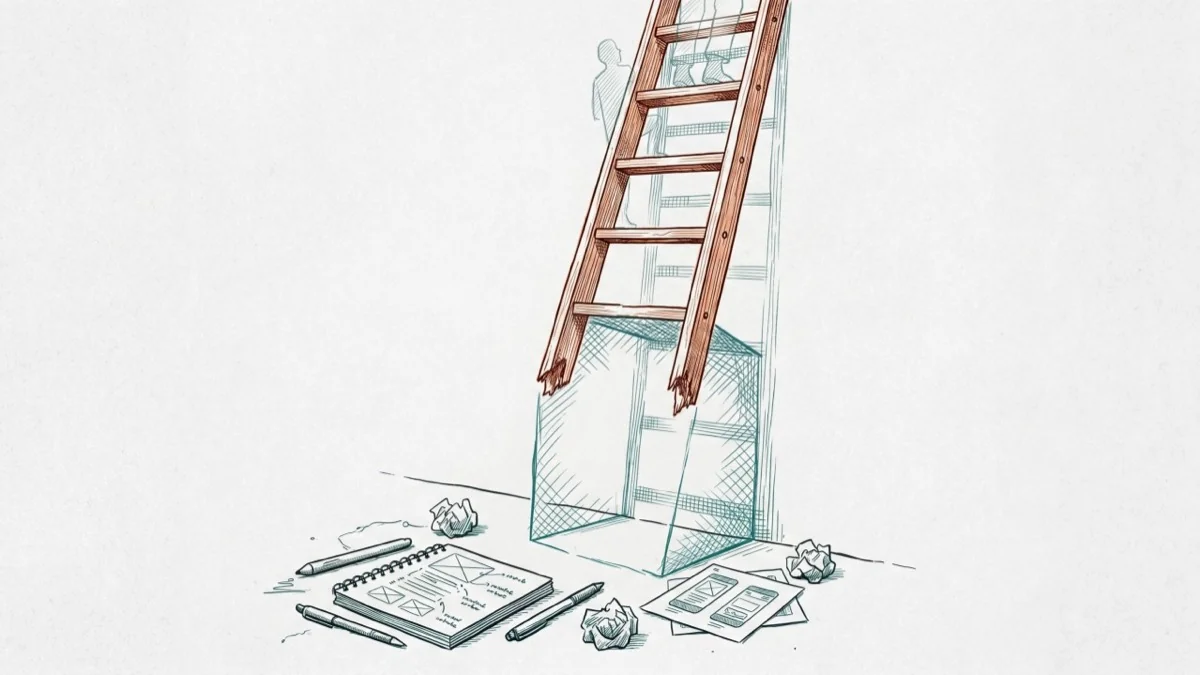
The Ladder We Are Removing
Companies are hiring fewer entry-level designers because AI can draft the basics in seconds. That is a colossal strategic blunder.
That foundational first step was never merely administrative red tape; it was the mandatory passageway to reach every subsequent stage of seniority. If nobody climbs that bottom rung, in a few years we will be staring at an empty void where Senior talent should stand.
The problem isn't AI itself. The problem is that we haven't yet figured out how the craft is learned when the first step has been removed.
Perhaps we need to invent entirely new ways to train those entering design. But doing so requires pausing to reflect, and right now, everyone is moving far too fast.
I remain anchored to the question in the title. After so many years in the classroom, it is the one question I am certain remains worth asking.